Texte disponible pour l'instant uniquement en anglais.
- Longueur
- 11 cm
- Poids
- 8 g
Présence dans le détroit
Abundant winter visitor to a wide range of habitats.
Identification
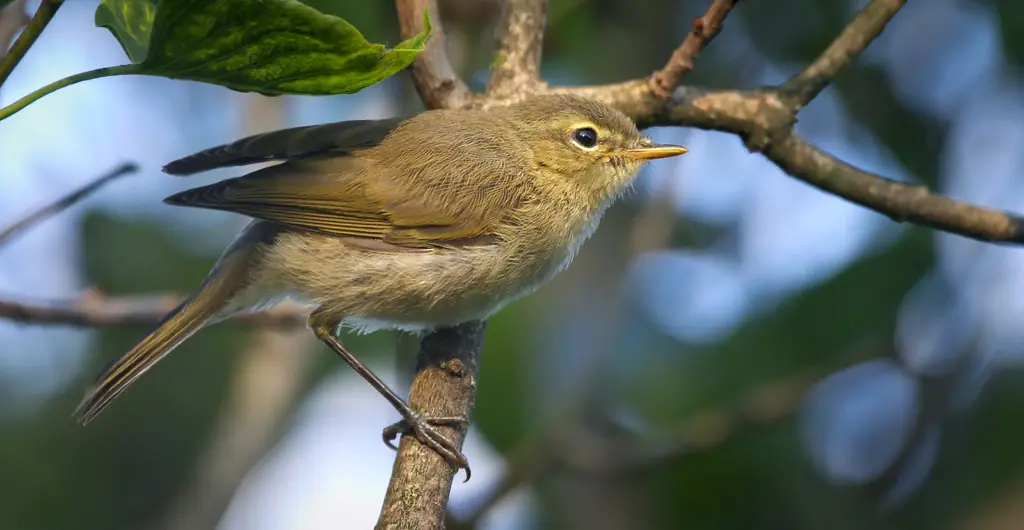
Small, of variable colouring, from greenish to brownish on upperparts, and off-white with variable yellowish tinges to underparts. The typical colouring is dark olive-green on upperparts and paler, yellowish-green underparts. Thin bill and dark legs. Wing-formula: 2nd primary normally between 8th and 9th or equal to the 8th.
Déplacements
The first birds arrive towards the middle of September and the last leave near the end of March. Postnuptial peaks between 2nd hf. October and 1st hf. November; prenuptial peak in 1st hf. March.
Reprises de bagues
Belgium (16), Germany (8), United Kingdom (8), Holland (5), France (4), Norway (1), Ireland (1), Channel Islands (1) and Sweden (1). Aparte de la subespecie nominal Phylloscopus collybita collybita del centro y oeste de Europa, durante el período invernal pueden llegar aves de otras subespecies; así encontramos: Apart from the nominate subspecies Phylloscopus collybita collybita from Central and West Europe, during the winter birds of other subspecies also occur, such as: Phylloscopus collybita abietinus Del norte y noroeste de Europa, casi igual que la nominal pero con menos verde por encima, menos amarillo por debajo y mayor longitud de ala plegada, entre 58 y 65 mm., que en P. c. collybita oscila entre 49 y 63 mm. From N and NW Europe, similar to the nominate but with less green above and less yellow below with a slightly longer wing-length best separated in the hand: between 58 and 65 mm., that in P.c.collybita ranges from 49 to 63 mm. Phylloscopus collybita tristis De la zona Eurosiberiana, con partes superiores pardas grisáceas, dorso y obispillo verdosos y bordes de plumas del ala y cola verdes; partes inferiores claras sin amarillo y los lados del pecho herrumbrosos claros. From the Ural area, Siberia, with brown-grey upperparts, green tinge to back, rump, wing and tail feather edges, pale underparts lacking yellow and rusty-buff breast-sides. Phylloscopus collybita lorenzii De la zona Caucásica, sin matices verdes ni amarillos, con partes superiores pardas grisáceas e inferiores de blancuzcas a cremas (ver Mosquitero Oriental). From the Caucasus area, lacking green or yellow, greyish brown upperparts and off-white underparts (see Mountain Chiffchaff). Sylviidae Mosquitero Común Phylloscopus collybita collybita P. c. abietinus P. c. tristis P. c. lorenzii Mosquitero Ibérico Mosquitero Ibérico Phylloscopus ibericus / Iberian Chiffchaff L 11 / P 8 Estatus: Estival común de bosques. Identificación: Del mismo colorido tipo que el Mosquitero Común; se diferencian por el canto y su fenología, ya que en M. Ibérico sólo está presente entre marzo y septiembre, y el M. Común entre septiembre y marzo. Movimientos: Máximo prenupcial en 2ª q. abril y postnupcial en 1ª q. agosto. Status: Common summer visitor to forests. Identification: The same plumage as a Chiffchaff; they differ in their song and phenology, as the Iberian Chiffchaff is only present between March and September, and the Chiffchaff between September and March. Movements: Prenuptial peak in 2nd hf. April and postnuptial peak in 1st hf. August.
Texte éditorial de Bioestrecho. Dernière révision : 8 septembre 2026.
Galerie
DétroitTom Riggle, CC BY-SA · 2017
DétroitChristoph Moning, CC BY · 2025
DétroitChristoph Moning, CC BY · 2025
DétroitTero Linjama, CC0 · 2025
DétroitLoïc Chalmandrier, CC BY · 2025
DétroitLoïc Chalmandrier, CC BY · 2025